
Conversations with Ben, Part One : Frozen Knuckles, Variant Behavior and Market Levels

I am a huge fan of Ben Graham.
One of the first books that the man I call (probably to his dismay) my mentor was the Intelligent Investor. That was the first book that took me from just a salesman to an investor.
I ended up in the finance and investing business for the simple reason that selling vacuum cleaners door to door is a lot more fun in the summer months than in a Baltimore January with snow and ice.
Selling door to door was all I knew. I had sold books and magazines for 4 years out of high school and eventually came back to Baltimore and took a job selling vacuum cleaners.

I was good at it.
I would constantly hit the incentive numbers and win whatever little prize was on the table for the month.
I made pretty damn good money for a 23-year-old who dropped out and took a GED.
I hated the cold.
I was sharing my distrust of the cold with a friend of my father's one evening and he suggested he could get me a job selling insurance with his company.
A few interviews later and I went to work for the John Hancock Company in Baltimore.
This was in the early days of financial planning and variable insurance products.
In addition to an insurance license I got my Series 22 so I could sell limited partnerships and mutual funds.
I was not the best ever, but I was not the worst.
At some point after a family kerfuffle I ended up transferring to the West Coast and practicing my craft in a military town selling to US Air Force personnel.
One of the guys in my office was a retired Air Force master sergeant who was one of the smartest men I have ever met.
He taught me a lot about insurance and really sparked my interest in the stock market.
Through a series of fortunate events (apologies to Daniel Handler) I eventually became a stockbroker and very quickly found out the hard way how much I did not know.
And that was how I was introduced to Benjamin Graham.
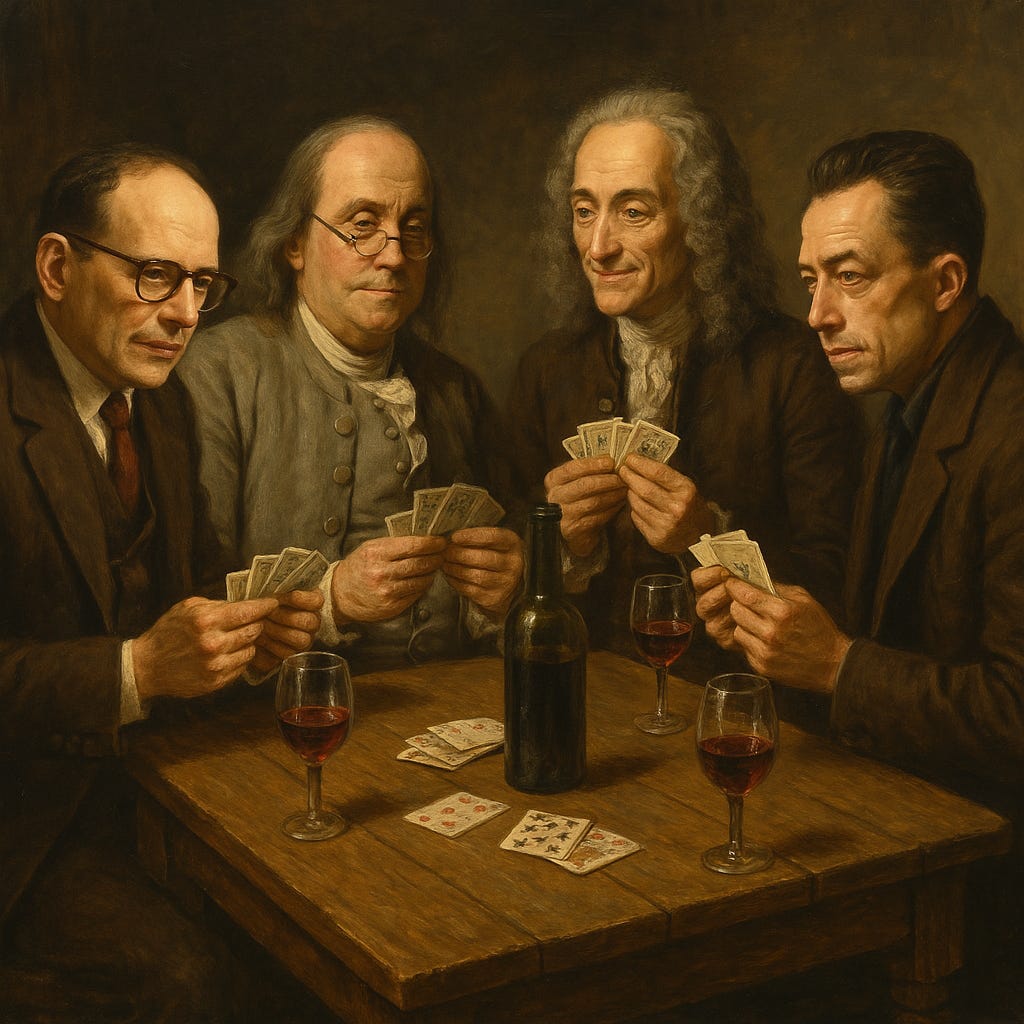
In the picture that often adorns this site it is Graham along with Voltaire, Benjamin Franklin and Albert Camus that form the portrait of foundational thinkers I use as something of a logo.
In my inbox this week I got the usual offerings from Joe Koster at Value Investing World with a bunch of links on the topic of investing. In it was a link to a Jason Zweig piece from 2015 that contains a speech Ben Graham gave in November 1963 at the Saint Francis Hotel in San Francisco.
Speaking on the topic of Securities in an Insecure World Graham addressed what he considered to be two dangerous fallacies then being peddled as gospel.
First is the idea that stocks are always attractive and no consideration at all should be paid to general stock market levels.
Graham discussed several historical examples of wide swings in the market and suggested that "These very wide swings underline the fact that the stock market is basically the same now as it always was, in the sense that it is still subject to very substantial overvaluation at some times and undoubtedly substantial undervaluation at others."
In other words, make volatility your best friend and not your worst enemy.
The marketing machine still pumps out this dangerous notion, especially with index funds.
Ask a 55-year-old man who put all his money in index funds on the advice of the professionals in 1999 if market levels matter.
On the flip side his daughter who bet it all on QQQ in 2009 had timing work out decidedly in her favor.
Graham advised that "My basic conclusion is that investors as well as speculators must be prepared in their thinking and in their policy for wide price movements in either direction. They should not be taken in by soothing statements that a real investor doesn't have to worry about the fluctuations of the stock market."
The second notion Graham discussed is one that infects almost everyone active in the markets.
He talked about the fact that Wall Street and the advisory industry is fond of the idea that stock selection is the only thing that matters and no attention needs to be paid to market movement.
Ben disagreed for three reasons:
"The first is that I doubt that the market is really so much different in this respect from what it always was in the past.
"The second reason is that there is actually a considerable underlying consistency in the stock market if you measure its movements by comparing two averages which seem to be quite different. One of them is the Dow Jones Industrial Average, which consists of only 30 stocks, and the other is the Standard & Poor's Composite, which consists of 500 stocks."
Graham found that when the market fell sharply, most stocks fell.
When the markets rose, most stocks went up.
"I think the third and most important reason why the investor should not be led to emphasize his selection of individual stocks, and to neglect the general level of the stock market, is the fact that there is no indication that the investor can do better than the market averages by making his own selections or by taking expert advice."
This was the tough one for the audience to believe that Graham, the father of Value investing, said that most investors cannot beat the market even with professional help.
That unfortunately remains true today.
Graham did hold out some hope for investors when he said "I do believe it is possible for a minority of investors to get significantly better results than the average. Two conditions are necessary for that. One is that they must follow some sound principles of selection which are related to the value of the securities and not to their market price action. The other is that their method of operation must be basically different from that of the majority of security buyers. They have to cut themselves off from the general public and put themselves into a special category."
In the closing portion of the talk he gives out some more hope when he said "I do believe it is possible for a minority of investors to get significantly better results than the average. Two conditions are necessary for that. One is that they must follow some sound principles of selection which are related to the value of the securities and not to their market price action.
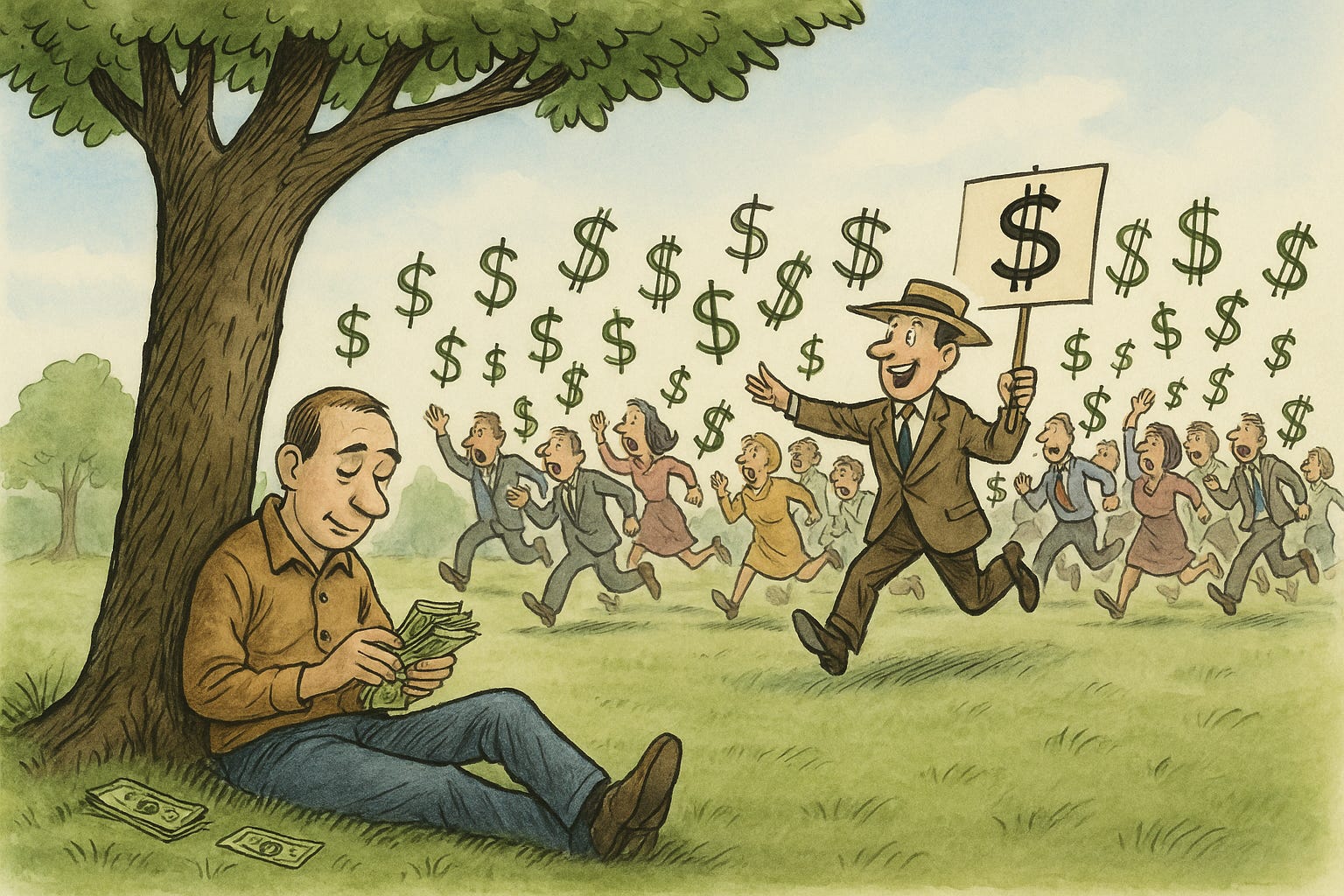
The other is that their method of operation must be basically different from that of the majority of security buyers. They have to cut themselves off from the general public and put themselves into a special category."
I think it is possible for some strong-minded investors to do this, by buying value rather than prospects or popularity. Some examples of this approach:
Select stocks of important companies which sell on a no-glamour basis.
Buy definitely "bargain issues." Typically these would be shares that sold for less than their value in working capital alone, with nothing paid for fixed assets and goodwill. Finally there is the wide field of "special situations" such as reorganizations, mergers, takeovers, liquidations, etc. This is a professional area, but it is not impossible for intelligent investors to profit handsomely from it if they approach security operations as they would a commercial business.
Graham added that "He must make a strong effort to have more money invested in common stocks at lower market levels (at least on the basis of cost) than at what he recognizes to be potentially high levels. Most important, he must maintain a philosophical attitude toward the inescapable variations in his financial position and the inevitable "mistakes" associated with these variations."
The big takeaways:
Market levels matter
You probably cannot predict market movements. React to what does happen rather than trying to predict what might happen
To outperform you must think and act differently than everyone else.
Everyone thinks that Ben Graham was focused on just low PE stocks and that his kind of thinking went out with tassel loafers and muscle cars.
Nothing could be further from the truth, and we will explore this a bit more in the weeks ahead as well as some other ways to be different than the pack and escape the noise of Wall Street and the Instant Experts of the Internet.
I will close with Graham's suggestion to "do something foolish, something creative and something generous" every day.
I usually have foolish knocked out early in the day but increasingly I try to make sure I get the other two in on a daily basis as well.